 The
Rational Argumentator
The
Rational Argumentator

Free Tools for Rational Education
Topology Practice Problems and Solutions
Homeomorphisms Between Squares and Circles in Topology
This section is part of Mr. Stolyarov's Topology Problems and Solutions.
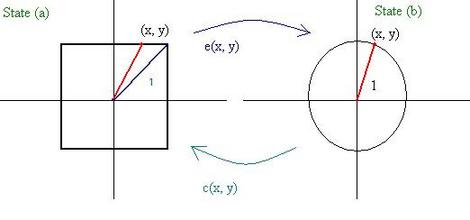
Problem ST1-1: In the included diagram, the function e(x, y) transforms a square of diagonal length 2, centered at the origin, into a unit circle of radius 1, centered at the origin. The function c(x, y) transforms the unit circle back into the square. It is known that e(x, y) = (x/√(x2 + y2), y/√(x2 + y2)). Find an expression equivalent to c(x, y).
Solution ST1-1: We consider the square in the first quadrant of State (a), formed by the larger square and the x and y axes. This square has diagonal length 1. The height of a square with diagonal length 1 is 1/√(2).
In State (b), any ordered pair on the circle that is between 45o and 135o CCW gets mapped by c(x, y) to an ordered pair (x', y') in State (a) where y' = 1/√(2). Then x' becomes x(1/√(2))/y = x/(√(2)y).
Any ordered pair on the circle that is between 225o and 315o CCW gets mapped by
c(x, y) to an ordered pair to an ordered pair (x', y') in State (a) where y' = -1/√(2). Then
Then x' becomes x(-1/√(2))/y = x/(-√(2)y).
Any ordered pair on the circle that is between 0o and 45o CCW as well as between 135o and 180o CCW gets mapped by c(x, y) to an ordered pair (x', y') in State (a) where x' = 1/√(2). Then y' becomes y(1/√(2))/x = y/(√(2)x).
Any ordered pair on the circle that is between 180o and 225o CCW as well as between 315o and 0o CCW gets mapped by c(x, y) to an ordered pair (x', y') in State (a) where x' = -1/√(2). Then y' becomes y(-1/√(2))/x = y/(-√(2)x).
Thus,
c(x, y) = (x/(√(2)y), 1/√(2)) for │x│≤│y│and y > 0
c(x, y) = (-x/(√(2)y), -1/√(2)) for │x│≤│y│and y < 0
c(x, y) = (1/√(2), y/(√(2)x) for │y│≥│x│ and x > 0
c(x, y) = (-1/√(2), -y/(√(2)x) for │y│≥│x│ and x < 0
In transforming the circle in State (b) to a square in State (a), the vector
(x, y) will be scaled by 1/(√(2)│x│) or 1/(√(2)│y│) , whichever is greatest. Thus,
c(x, y) = (x/[√(2)max{│x│, │y│}] , y/[√(2)max{│x│, │y│}])
Problem ST1-2: Verify that c(x, y) and e(x, y) are inverses.
Solution ST1-2:
We first show that c◦e(x, y) = (x, y) for all values of (x, y).
c(e(x, y)) = c(x/√(x2 + y2), y/√(x2 + y2))
Then
c(e(x, y)) = ([x/√(x2 + y2)]/(√(2)[y/√(x2 + y2)]), 1/√(2)) for │x│≤│y│and y > 0
c(e(x, y)) = (-[x/√(x2 + y2)]/(√(2)[y/√(x2 + y2)]), -1/√(2)) for │x│≤│y│and y < 0
c(e(x, y)) = (1/√(2), [y/√(x2 + y2)]/(√(2)x/√(x2 + y2)) for │y│≥│x│ and x > 0
c(e(x, y)) = (-1/√(2), - [y/√(x2 + y2)]/(√(2)x/√(x2 + y2)) for │y│≥│x│ and x < 0
Thus,
c(e(x, y)) = (x/(√(2)y), 1/√(2)) for │x│≤│y│and y > 0
c(e(x, y)) = (x/(-√(2)y), -1/√(2)) for │x│≤│y│and y < 0
c(e(x, y)) = (1/√(2), y/(√(2)x)) for │y│≥│x│ and x > 0
c(e(x, y)) = (-1/√(2), y/(-√(2)x)) for │y│≥│x│ and x < 0
But since the for │x│≤│y│, y > 0, y = 1/√(2), it follows that x/(√(2)y) = x/(√(2)/√(2)) = x, so c(e(x, y)) = (x, y) for │x│≤│y│and y > 0.
Moreover, since the for │x│≤│y│, y < 0, y = -1/√(2), it follows that x/(-√(2)y) =
x/(-√(2)/-√(2)) = x, so c(e(x, y)) = (x, y) for │x│≤│y│and y < 0.
But since the for │y│≤│x│, x > 0, x = 1/√(2), it follows that y/(√(2)x) = y/(√(2)/√(2)) = y, so c(e(x, y)) = (x, y) for │y│≤│x│and x > 0.
Moreover, since the for │y│≤│x│, x < 0, x = -1/√(2), it follows that y/(-√(2)x) =
y/(-√(2)/-√(2)) = y, so c(e(x, y)) = (x, y) for │y│≤│x│and x < 0.
Thus, c◦e(x, y) = (x, y) for all values of (x, y).
Now we show that e◦c(x, y) = (x, y) for all values of (x, y).
e(c(x, y)) =
e(x/(√(2)y), 1/√(2)) for │x│≤│y│and y > 0
e(-x/(√(2)y), -1/√(2)) for │x│≤│y│and y < 0
e(1/√(2), y/(√(2)x) for │y│≥│x│ and x > 0
e(-1/√(2), -y/(√(2)x) for │y│≥│x│ and x < 0
Thus,
e(c(x, y)) =
(x/y√(2x2/2y2 + 1), 1/√(2x2/2y2 + 1)) for │x│≤│y│and y > 0
(-x/y√(2x2/2y2 + 1), -1/√(2x2/2y2 + 1)) for │x│≤│y│and y < 0
(1/√(2y2/2x2 + 1), y/x√(2y2/2x2 + 1)) for │y│≥│x│ and x > 0
(-1/√(2y2/2x2 + 1), - y/x√(2y2/2x2 + 1)) for │y│≥│x│ and x < 0
Thus,
e(c(x, y)) =
(x/y√((x2+y2)/y2)), 1/√((x2+y2)/y2))) for │x│≤│y│and y > 0
(-x/y√((x2+y2)/y2)), -1/√((x2+y2)/y2))) for │x│≤│y│and y < 0
(1/√((x2+y2)/x2)), y/x√((x2+y2)/x2))) for │y│≥│x│ and x > 0
(-1/√((x2+y2)/x2)), - y/x√((x2+y2)/x2))) for │y│≥│x│ and x < 0
On a unit circle, √(x2+y2) = 1, so
e(c(x, y)) =
(x√(y2)/y, √(y2)) for │x│≤│y│and y > 0
(-x√(y2)/y, -√(y2)) for │x│≤│y│and y < 0
(√(x2), y√(x2)/x) for │y│≥│x│ and x > 0
(-√(x2), -y√(x2)/x) for │y│≥│x│ and x < 0
In all four cases above, e(c(x, y)) simplifies to (x, y).
Thus, e◦c(x, y) = (x, y) for all values of (x, y).
Hence, we have shown that c(x, y) and e(x, y) are inverses. Q. E. D.
Gennady Stolyarov II (G. Stolyarov II) is an actuary, science-fiction novelist, independent philosophical essayist, poet, amateur mathematician, composer, and Editor-in-Chief of The Rational Argumentator, a magazine championing the principles of reason, rights, and progress.
In December 2013, Mr. Stolyarov published Death is Wrong, an ambitious children’s book on life extension illustrated by his wife Wendy. Death is Wrong can be found on Amazon in paperback and Kindle formats.
Mr. Stolyarov has contributed articles to the Institute for Ethics and Emerging Technologies (IEET), The Wave Chronicle, Le Quebecois Libre, Brighter Brains Institute, Immortal Life, Enter Stage Right, Rebirth of Reason, The Liberal Institute, and the Ludwig von Mises Institute. Mr. Stolyarov also published his articles on Associated Content (subsequently the Yahoo! Contributor Network) from 2007 until its closure in 2014, in an effort to assist the spread of rational ideas. He held the highest Clout Level (10) possible on the Yahoo! Contributor Network and was one of its Page View Millionaires, with over 3.1 million views.
Mr. Stolyarov holds the professional insurance designations of Associate of the Society of Actuaries (ASA), Associate of the Casualty Actuarial Society (ACAS), Member of the American Academy of Actuaries (MAAA), Chartered Property Casualty Underwriter (CPCU), Associate in Reinsurance (ARe), Associate in Regulation and Compliance (ARC), Associate in Personal Insurance (API), Associate in Insurance Services (AIS), Accredited Insurance Examiner (AIE), and Associate in Insurance Accounting and Finance (AIAF).
Mr. Stolyarov has written a science fiction novel, Eden against the Colossus, a philosophical treatise, A Rational Cosmology, a play, Implied Consent, and a free self-help treatise, The Best Self-Help is Free. You can watch his YouTube Videos. Mr. Stolyarov can be contacted at gennadystolyarovii@yahoo.com.
Click here to return to the index of Free Tools for Rational Education.
Learn about Mr. Stolyarov's novel, Eden against the Colossus, here.Read Mr. Stolyarov's comprehensive treatise, A Rational Cosmology, explicating such terms as the universe, matter, space, time, sound, light, life, consciousness, and volition, here.